7 Best Ultralight Trail Runners for Backpacking, Ranked
Trail runners have replaced boots for most ultralight backpackers because they dry fast, need no break-in, and shave pounds off your feet where weight matters most. This shortlist covers seven current models, ranked by how well they balance protection, grip, and packable weight for multi-day trail use. Each pick below genuinely qualifies as a lightweight trail runner suited to backpacking rather than casual road running.
- Stack height and lug depth matter more than brand loyalty once you're carrying a pack
- A wider toe box prevents blisters and black toenails on long descents
- Mesh uppers dry fast but offer less protection from scree and roots
- The right shoe depends on terrain: mud, buffed trail, and rocky technical ground each favor different outsoles
- Best Overall — Hoka Speedgoat 6: Thru-hikers and backpackers who need max cushion and grip on rocky, technical terrain over many consecutive days
- Most Protective — Brooks Cascadia 18: Backpackers carrying heavier packs who want a stable, durable workhorse over a fast-and-light shoe
- Best Fit for Varied Terrain — Saucony Peregrine 14: Hikers who want a secure, glove-like fit with reliable grip across mixed rocky and root-strewn trail
- Best for Mud and Soft Terrain — Salomon Speedcross 6: Backpackers hiking consistently wet, muddy, or soft-ground routes where traction is the priority
- Best Value — Salomon Sense Ride 5: Backpackers wanting a balanced, no-compromise shoe without paying for specialized features they will not use
- Lightest — Hoka Torrent 3: Fast, mile-hungry backpackers on moderate terrain who prioritize low weight over rugged protection
The picks, reviewed in detail
Best Overall
Hoka Speedgoat 6
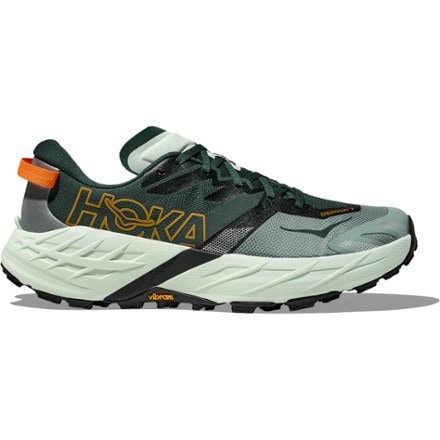
- Vibram Megagrip outsole holds on wet rock and loose scree
- Thick CMEVA midsole absorbs impact late in long days
- 5mm lugs bite into loose trail without feeling clunky
- Higher stack height reduces ground feel for those who prefer minimalist gait
- Mesh upper offers less structure for ankle stability on steep sidehills
The Speedgoat 6 has become a default recommendation among long-distance hikers, and the spec sheet explains why. Vibram Megagrip is simply a stickier, more durable rubber compound than most in-house outsoles, and the 5mm lugs are deep enough for loose dirt and moderate mud without becoming a liability on rock. The tall CMEVA midsole gives real protection against root and rock bruising, which matters more on day twelve than day one. Fit runs true with a moderately roomy forefoot, though not as wide as dedicated wide-toe-box shoes. At 9.8 ounces it is not the lightest shoe here, but the tradeoff is real underfoot protection and outsole durability for high-mileage use. Breathability is decent but not class-leading; expect a normal dry-time in wet conditions, not exceptional. The honest limitation is that hikers who prioritize a low-to-ground, minimalist feel will find the stack height too high. For most backpackers logging serious miles on mixed and rugged terrain, though, this is the safest all-around choice.
Most Protective
Brooks Cascadia 18
- DNA LOFT v2 midsole provides substantial protection under a loaded pack
- TrailTack Green rubber holds up well across varied terrain
- Wider platform improves stability with heavier loads
- Heaviest shoe on this list at 11.1 oz, a real cost for ounce-counters
- Less nimble on technical rock scrambling than lower-profile options
The Cascadia has long been the choice for hikers who want a trail runner that behaves more like a supportive daily hiker than a race shoe, and the 18th iteration keeps that identity intact. The DNA LOFT v2 midsole is tuned for cushioning under sustained load rather than springy energy return, which suits backpackers carrying a full multi-day kit rather than fastpackers moving quick and light. TrailTack Green rubber grips reliably across dirt, root, and moderate rock, though it is not as sticky as Vibram Megagrip on wet stone. The wider, more stable platform reduces ankle roll risk on uneven trail, a real consideration once fatigue sets in late in the day. Fit is accommodating through the midfoot with a secure heel lockdown. The obvious tradeoff is weight: at 11.1 ounces this is the heaviest shoe on this list, which matters over thousands of steps per day. Breathability is adequate but the shoe is built more for durability than fast drying. Choose this one if stability and protection under load outweigh the priority of shaving grams.
Best Fit for Varied Terrain
Saucony Peregrine 14
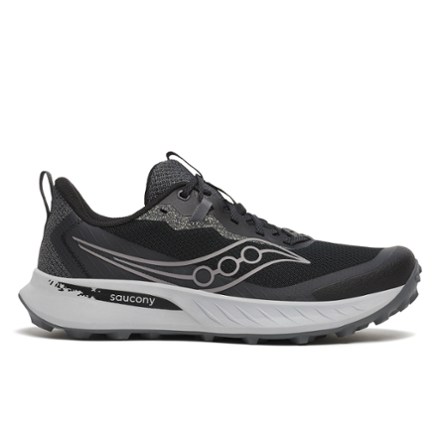
- PWRTRAC outsole with 5mm lugs grips well across rock, root, and loose dirt
- PWRRUN midsole balances cushioning with responsiveness
- Secure, snug fit reduces foot movement on descents
- Snug fit may feel tight for wider feet without sizing up
- Less max-cushion protection than the Speedgoat for very long days
The Peregrine 14 targets hikers who want precision and grip more than maximum cushioning. PWRTRAC rubber with 5mm lugs performs well across a genuine range of surfaces, from loose dirt to wet root systems, which makes it a sensible pick for trail that changes character mile to mile. The PWRRUN midsole strikes a middle ground: enough cushioning to protect on long days, without the taller stack that some hikers find unstable on technical descents. Saucony's fit runs snug and secure through the midfoot and heel, which many find reassuring on sidehill traverses, though hikers with wider feet may need to size up half a size. At 9.4 ounces it sits comfortably in the lightweight range without sacrificing outsole durability. The upper is well-ventilated for its protection level, drying reasonably fast after stream crossings. The honest limitation is that it does not offer the same all-day cushioning as the Speedgoat on the longest, most punishing days. For hikers who value precise foot placement and grip over sheer cushioning, this is a strong, versatile choice.
Best for Mud and Soft Terrain
Salomon Speedcross 6
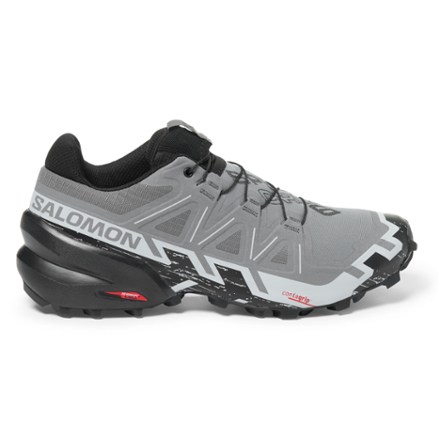
- Deep, aggressive lugs shed mud and grip soft ground exceptionally well
- Contagrip mud-specific outsole outperforms general-purpose rubber in wet conditions
- SensiFit upper provides a locked-in, precise fit
- Aggressive lugs feel less efficient and slower on hardpack or road sections
- Heavier and less breathable than more general-purpose options here
The Speedcross 6 is a specialist, and it should be chosen with that in mind. The deep, widely-spaced lugs are designed specifically to shed mud rather than pack up with it, which is a real functional advantage on consistently soft, wet, or boggy trail where other shoes lose traction. Contagrip's mud-specific compound reinforces that focus, though it is a step behind Vibram Megagrip on dry rock. The SensiFit upper wraps the midfoot securely, giving a precise, locked-down feel that many find reassuring on uneven, slippery ground. At 10.1 ounces it is not the lightest option, and the aggressive lug pattern creates a rockered, less efficient stride on buffed trail or road sections between trailheads. Breathability is modest given the more substantial upper construction, so dry time after saturation runs longer than the mesh-forward options on this list. This is not a general-purpose recommendation. For backpackers whose routes regularly cross wet, muddy, or soft terrain, though, the traction advantage is difficult to replicate with a more generalist shoe.
Best Value
Salomon Sense Ride 5
- Well-rounded performance across cushion, grip, and agility without major weaknesses
- Energy Surge midsole feels responsive over long miles
- Tied for lightest shoe on this list at 8.7 oz
- Lacks the deep-lug specialization for true mud or the max-cushion protection for the longest days
- Contagrip outsole is capable but not the stickiest option here on wet rock
The Sense Ride 5 is built to do everything reasonably well rather than excel narrowly, and for many backpackers that generalist approach is exactly right. At 8.7 ounces it ties for the lightest shoe on this list while still delivering a genuinely cushioned ride via the Energy Surge midsole, which feels lively rather than dead underfoot over consecutive days. The Contagrip outsole handles dirt, root, and moderate rock competently, though it will not match the Speedcross in mud or the Speedgoat's Megagrip on wet stone. Fit is agile and closer to the ground than the Speedgoat, which suits hikers who prefer better trail feel and quicker direction changes over maximum stack height. This makes it a sound choice for hikers who move across varied terrain in a single day rather than specializing in one surface type. The honest tradeoff is that it does not lead in any single category the way the more specialized shoes on this list do. Breathability is solid for a shoe with this level of structure. For the price and weight, it represents one of the more balanced packages here, which is why it earns the value nod.
Lightest
Hoka Torrent 3
- Lightest shoe on this list at 8.7 oz, notable for reducing swing weight over long days
- Recycled mesh upper breathes well and dries quickly
- Low-to-ground platform gives responsive, efficient turnover
- Less underfoot protection than max-cushion options on rocky or root-heavy trail
- Lower stack height and lighter build mean reduced durability over very high mileage
The Torrent 3 is built around the principle that lighter feet cost less energy over a full day, and Hoka has kept the weight down without abandoning cushioning entirely. PROFLY foam gives a lower-to-ground ride than the Speedgoat, favoring quick, efficient turnover over maximum shock absorption, which suits hikers covering moderate, less technical terrain at pace. The recycled mesh upper is genuinely breathable and dries fast after stream crossings or rain, a real advantage on multi-day trips where wet feet compound blister risk. Fit is close to true-to-size with a moderate toe box, comfortable for most feet without the roominess of dedicated wide-fit models. The honest tradeoff is protection: the lower stack and lighter overall build mean more trail feedback on sharp rock and roots, and durability over very high mileage will lag behind beefier options. This is not the shoe for consistently technical, rugged terrain. But for backpackers who prioritize covering ground efficiently on moderate trail and want to minimize weight on their feet above nearly everything else, the Torrent 3 delivers a genuinely lightweight package without feeling flimsy.
Best for Mixed Road and Trail
Hoka Challenger 7
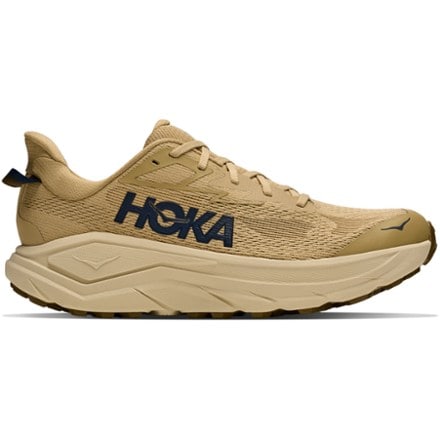
- Smaller lug pattern rolls smoothly on hardpack and pavement sections
- CMEVA cushioning protects well for its weight class
- Versatile enough for approach hikes and road-to-trailhead stretches
- Smaller lugs offer less bite on loose, steep, or muddy terrain
- Less specialized for technical backpacking than deeper-lug options here
The Challenger 7 fills a specific niche: hikers whose routes involve real stretches of road, forest track, or well-groomed trail between the technical sections. The smaller lug pattern, compared to the Speedgoat's aggressive tread, rolls more efficiently on hardpack and pavement, which matters if your itinerary includes trailhead road-walks or rail-trail connectors. CMEVA cushioning is shared with the Speedgoat, so underfoot protection remains solid for the weight class even though the outsole is less aggressive. At 8.9 ounces it sits mid-pack for weight, striking a reasonable balance for hikers who do not want to commit fully to either a max-grip or ultralight-minimalist shoe. Fit is comfortable and true-to-size with adequate room in the forefoot. The clear tradeoff is technical capability: the shallower lugs will not perform as well as the Speedgoat or Speedcross on steep, loose, or muddy terrain. This is a sensible choice for hikers who know their route skews toward moderate, mixed-surface trail rather than sustained technical backcountry.
At a glance
| Spec | Hoka Speedgoat 6 | Brooks Cascadia 18 | Saucony Peregrine 14 |
|---|---|---|---|
| Weight | 9.8 oz | 11.1 oz | 9.4 oz |
| Price | $155 | $140 | $140 |
What to look for
Toe box shape matters more on multi-day trips than most hikers expect, because feet swell and splay after hours on trail with a loaded pack. A shoe that fits fine on a store floor can crush toes by mile fifteen if the forefoot is narrow. Look at how much the upper flares at the toes and consider sizing up half a size from your normal running shoe if you know your feet swell significantly during long hiking days.
Stack height and heel-to-toe drop should match your existing gait rather than whatever is trendy. Higher stack shoes like the Speedgoat protect better against rock bruising but reduce ground feel and can feel less stable on technical sidehills for hikers not used to them. Lower stack, lower drop shoes like the Torrent reward efficient, midfoot-strike gaits but transmit more trail feedback directly into your feet, which compounds over consecutive days.
Outsole rubber compound and lug depth should be chosen for your actual terrain, not worst-case terrain you rarely encounter. Sticky compounds like Vibram Megagrip excel on wet rock and technical scrambling, aggressive deep lugs like Contagrip mud tread excel in soft, muddy conditions, and moderate all-purpose lugs handle mixed trail without the rolling penalty of aggressive tread on hardpack. Buying the most aggressive shoe available is not automatically the right call if most of your mileage is on buffed trail.
Breathability and dry time directly affect blister risk and foot health on multi-day trips. A highly breathable mesh upper dries fast after stream crossings or rain, reducing the maceration that leads to blisters and trench foot, but offers less structure and protection than a denser upper. Underfoot protection from rock plates or dense midsole foam matters more the longer and more technical your trip, since foot fatigue from repeated impact accumulates day over day, and expected mileage before the outsole or midsole breaks down should factor into cost-per-mile thinking rather than sticker price alone.
- Check forefoot width against your foot's actual shape, not just overall shoe length
- Match stack height and drop to your current running or hiking shoe if it works well for you
- Match outsole lug pattern and rubber compound to your specific trip's terrain and moisture
- Prioritize mesh breathability if your route includes frequent stream crossings or wet climates
- Consider rock plate or midsole density if your trail is rocky, rooty, or otherwise technical
- Factor in expected outsole and midsole lifespan relative to your annual mileage, not just upfront price
How to choose
Start with your terrain: consistently muddy or soft ground favors the Speedcross's aggressive lugs, while mixed road and buffed trail favors the Challenger's smoother tread. If you are covering long, technical, rocky mileage day after day, the Speedgoat's Megagrip outsole and cushioned midsole offer the most reliable all-around protection. Hikers carrying heavier packs who want stability and durability over minimal weight should look at the Cascadia. If shaving ounces is the top priority and your terrain is moderate, the Torrent's low weight and breathable upper make sense, while the Sense Ride offers a similarly light, more balanced alternative. Hikers who want a snug, precise fit with strong grip across varied surfaces should consider the Peregrine. Whichever you choose, prioritize actual foot shape and terrain match over brand reputation alone.
FAQ
Are trail runners actually durable enough for a long-distance backpacking trip?
Do I need a rigid shoe for ankle support with a heavy pack?
Should I size up for backpacking versus my normal running shoe size?
How much traction do I actually need for a typical backpacking route?
Is more cushioning always better for a multi-day trip?
How important is breathable mesh if I am hiking in a wet climate?
The bottom line
For most backpackers tackling varied, technical multi-day terrain, the Hoka Speedgoat 6 earns the top spot for its combination of Vibram Megagrip traction, genuine underfoot protection, and proven popularity on long trails. Hikers prioritizing traction in mud should step up to the Salomon Speedcross 6, while those chasing minimum weight on moderate terrain will do better with the Torrent 3 or Sense Ride 5. There is no single correct answer here, but the Speedgoat 6 remains the safest, most broadly capable choice for backpackers who need one shoe to handle whatever the trail throws at it.
Related guides
Keep building your system with these closely related guides.
Further reading
Authoritative sources to go deeper on the topics above.