
Chaco Z/Cloud vs Teva Hurricane XLT2: The 239-Gram Question for Backpackers Who Cross Streams
# Chaco Z/Cloud vs Teva Hurricane XLT2: The 239-Gram Question for Backpackers Who Cross Streams
Lighter, pricier, and sock-compatible — or cheaper, heavier, and discontinued? Here’s the honest breakdown.
You’re shin-deep in a cold Sierra Nevada creek, current pushing hard at your ankles, rocks slick with algae. Your trail runners are already soaked from the approach. The question isn’t whether you’ll cross — it’s what’s on your feet when you do, and whether those same shoes will be dry enough for camp in two hours. This is the exact scenario where camp sandals stop being a luxury and start being gear that earns their weight.
Two sandals dominate this conversation among non-minimalist backpackers: the Chaco Z/Cloud and the Teva Hurricane XLT2. One is lighter, more expensive, and built for decades of use. The other is cheaper, heavier, and — as of May 2026 — officially discontinued. Both have earned loyal trail followings. Neither is ultralight by any rigorous definition. But if you’re carrying one pair of sandals to handle water crossings and evening camp duties, the difference between them matters more than you’d think.
Specs at a Glance
| Feature | Chaco Z/Cloud | Teva Hurricane XLT2 |
|---|---|---|
| Weight (men’s sz 9, per pair) | 397–425g (14–15 oz) | 636g (22.4 oz) |
| Weight per sandal | ~200–213g (7.0–7.5 oz) | ~318g (11.2 oz) |
| Midsole | LUVSEAT polyurethane (Cloud compound) | EVA foam |
| Outsole | ChacoGrip rubber, 3.5mm lugs | Durabrasion Rubber |
| Strap system | Polyester jacquard, single-pull Z-strap | REPREVE recycled polyester, 3-point velcro |
| Arch support | Aggressive molded LUVSEAT | Contoured EVA, basic |
| Sock-compatible | Yes (no toe loop) | No (toe loop blocks) |
| Historical MSRP | $105 | $74.95 (men’s), $69.95 (women’s) |
| Current street price | $59.99–$105 | $44.99–$79.95 (clearance) |
| Drying speed | 60–90 min direct sun | 60–90 min direct sun |
| Status | Active | Discontinued — XLT3 is current |
| Amazon | Direct link (ASIN B000ZIEAVC) | Women’s direct link (ASIN B0B5LX4GWL) |
Weights are community-measured. Neither manufacturer publishes official weight data.
Deep Dive: Chaco Z/Cloud
The Build
The Z/Cloud is Chaco’s modernized take on their classic Z/1. The key change: the LUVSEAT midsole uses their “Cloud” polyurethane compound — softer and marginally lighter than the original. The outsole is unchanged. ChacoGrip rubber at 3.5mm lug depth handles wet rock, creek crossings, and slickrock with equivalent confidence. The footbed is molded polyurethane with diamond texture, not a foam insert. That distinction matters over multi-year use because PU foam resists compression far longer than EVA. You won’t be replacing the footbed in two seasons.
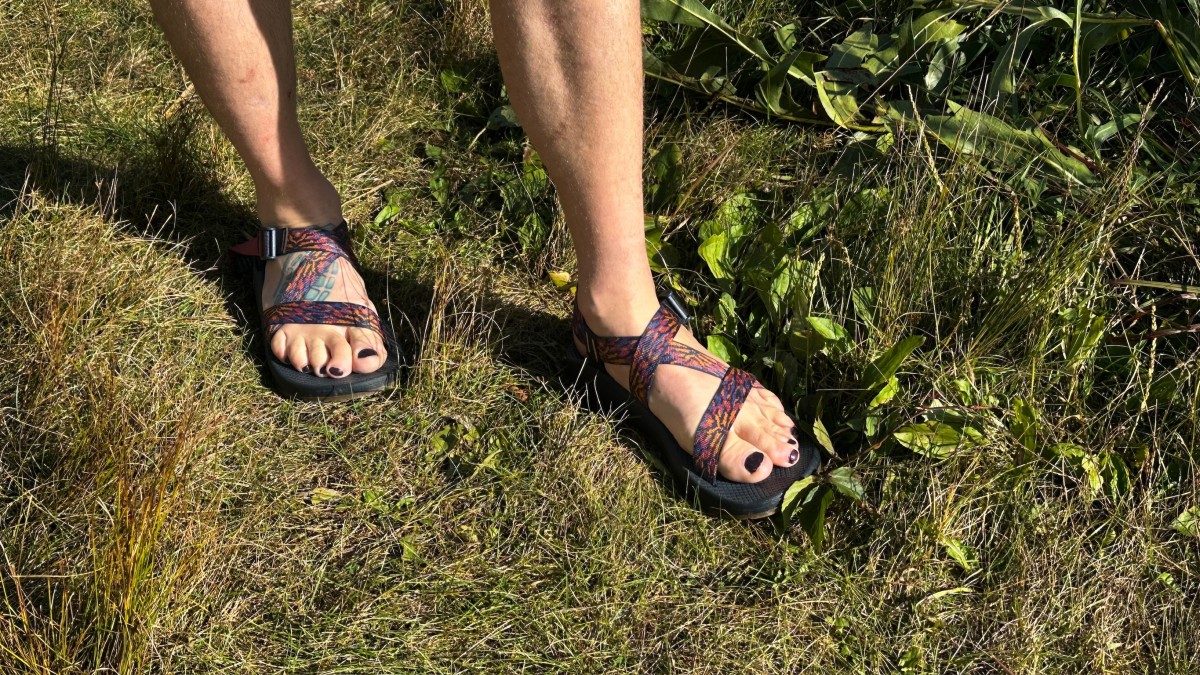
The strap system is the Z/Cloud’s signature engineering quirk. A single continuous polyester jacquard webbing weaves through the entire sandal, adjusted at a single pull point. There is no toe loop. The webbing threads between the first and second toe, and the whole system cinches or loosens with one pull once you understand the geometry. First-time users often spend five minutes figuring it out. After that, it becomes muscle memory.
Fit and Sock Compatibility
Chaco’s molded arch is aggressive. If you have high arches and currently wear orthotics, you’ll likely find the Z/Cloud tolerable or even ideal. If you have flat arches or have spent years in minimalist footwear, the pronounced arch shelf can create localized discomfort within the first hour. There is no break-in period for the materials themselves — OutdoorGearLab notes the Z/Cloud requires no break-in — but there is a fit adaptation period for the arch.
The absence of a toe loop is consequential for backpackers. Merino wool liner socks can be worn with the Z/Cloud, which makes these a credible late-season or high-elevation camp shoe when ambient temperatures drop below 50°F. That’s a legitimate functional advantage over any toe-loop competitor.
Durability and Repair
Chaco’s repair and replacement program is a real differentiator. The webbing can be replaced at Chaco repair centers or authorized cobblers. For through-hikers or people who wear sandals hard across multiple seasons, this shifts the cost calculus significantly. A $105 sandal that can be re-webbed twice is a better value than a $50 sandal that’s landfill after two seasons. The sandal is also vegan — no animal products in the construction, which matters to some buyers and is worth stating plainly.
Critical Assessment
The Z/Cloud is not light. At 397–425g per pair, it sits between camp shoe and boat anchor by UL standards. The Xero Z-Trail EV runs ~10.8 oz (306g) and costs $80. For pure ounce-counting, the Chaco loses. The LUVSEAT arch is polarizing — it’s a feature for some anatomies and a liability for others. The single-pull strap takes practice. And the $105 MSRP is hard to justify when you can find it on sale at $59.99.
Deep Dive: Teva Hurricane XLT2
The Build
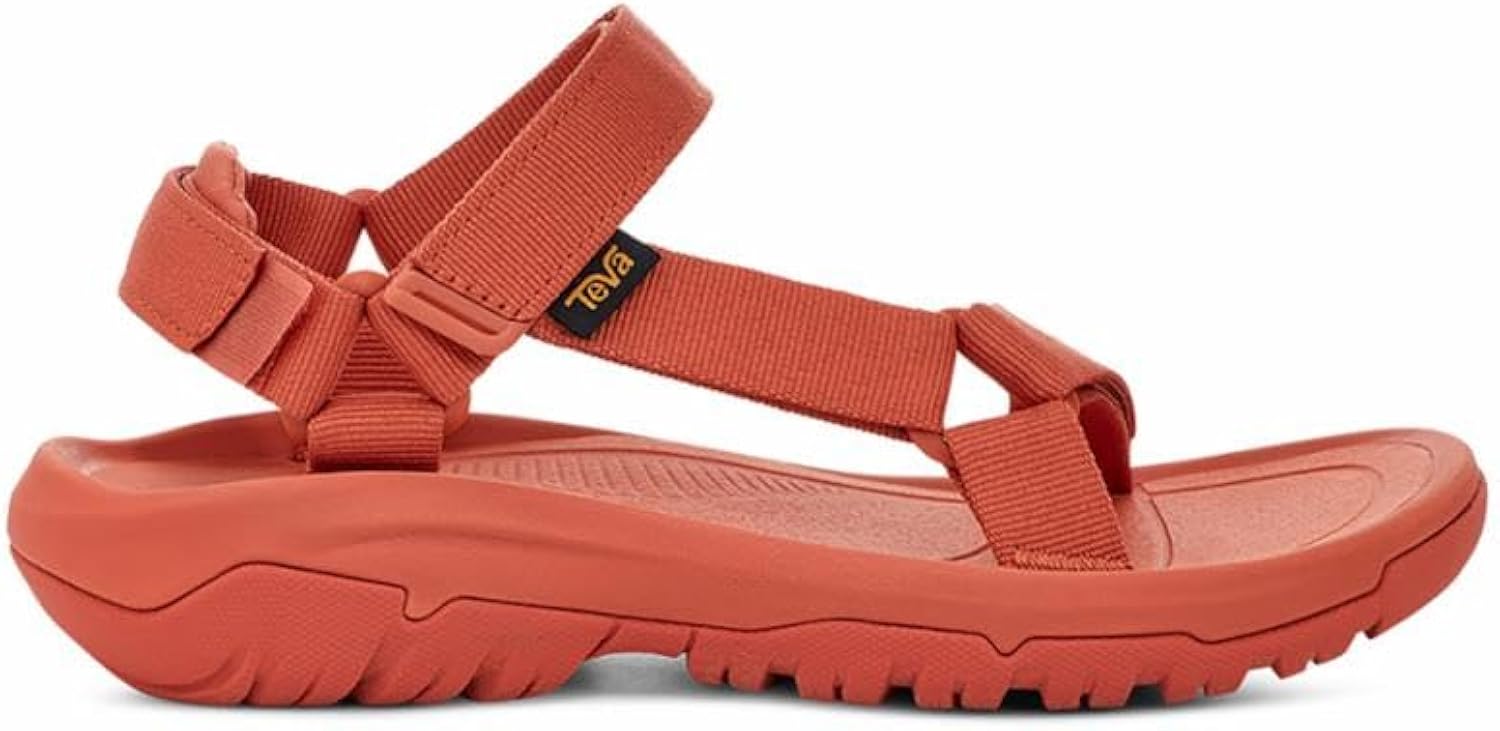
Teva’s XLT2 uses 100% REPREVE recycled polyester webbing — a genuine sustainability credential — and a Universal Strapping System that relies on three-point velcro adjustment at the toe, ankle, and heel. Unlike Chaco’s continuous webbing, the Teva straps operate independently. The midsole is standard EVA foam. The outsole is Teva’s Durabrasion Rubber, which performs adequately on wet surfaces but doesn’t inspire the same confidence as ChacoGrip on polished granite. A nylon shank adds torsional stability underfoot.
Fit
The velcro system is approachable and intuitive. Micro-adjustments are fast. That’s the XLT2’s main fit advantage: you can tweak it mid-hike without sitting down. The contoured EVA footbed provides basic arch contouring without the pronounced LUVSEAT shelf. Neutral-arched and flat-footed hikers often find the Teva more immediately comfortable for that reason.
The toe loop is a hard constraint. Socks don’t work. In cold camp conditions, this is a genuine limitation, not a minor inconvenience.
Durability
EVA foam is the compromised material here. It works fine for casual day use and moderate miles, but EVA compresses and hardens under sustained load. Over multiple seasons of hard use, the XLT2 footbed will flatten noticeably. Teva offers no repair program. When the XLT2 is done, it’s done.
Discontinuation Context
The XLT2 was officially discontinued in May 2026. Its replacement, the Hurricane XLT3, adds 5mm of additional EVA in the topsole — presumably for increased cushioning — but otherwise carries forward the same fundamental design. If you prefer the XLT2 and find it on clearance at $44.99, that’s a reasonable buy. But you’re buying into an end-of-life product. Parts won’t be refreshed. If the strap frays or the velcro loses adhesion, you’re shopping for a new sandal.
The women’s XLT2 remains available on Amazon with 11,682 ratings and a 4.5-star average — that review depth reflects years of legitimate use data, not a new product’s honeymoon period. Men’s availability varies by size and colorway; stock is clearing and won’t replenish.
Critical Assessment
The XLT2 is 239g heavier than the Z/Cloud in men’s sizing. That’s the dominant fact. At 636g per pair, it’s nearly impossible to justify on a weight-per-function basis unless the clearance pricing drops it far below what the Chaco is available for. The velcro system is convenient but less durable than woven webbing over time. And the discontinuation issue isn’t just philosophical — it means no future warranty support, no replacement parts, and decreasing size availability as stock depletes.
Weight and Drying Analysis
The Weight Math
Chaco Z/Cloud: 397–425g per pair (men’s size 9)
Teva Hurricane XLT2: 636g per pair (men’s size 9)
Difference: 211–239g, approximately 38% lighter for the Chaco
Against the UL benchmark field: the Xero Z-Trail EV at ~306g and the Mayfly Imago at ~170g illustrate just how much weight both of these sandals carry relative to purpose-built ultralight options. Neither Chaco nor Teva is a lightweight sandal. If raw gram count is the only metric, both fail the UL test. They only earn their place in a pack when a single item covers two roles: water crossing protection and evening camp footwear. Carrying one sandal instead of two separate items is the only scenario where the math pencils out.
The Chaco’s 38% weight advantage is meaningful. Over a 5-day trip, that’s 211–239g sitting in your pack or on your feet every evening that you’re not spending on calories, first aid, or sleep system.
Drying Performance
Neither manufacturer publishes drying time data. Based on community-reported anecdotal data, both sandals dry within 60–90 minutes in direct sun and 2–3 hours in shade. Both use polyester webbing, which dries faster than cotton or canvas. The practical difference: Teva’s EVA footbed can absorb water if the foam surface is compromised or compressed through wear. A heavily used XLT2 may hold moisture longer than a newer one. The Chaco’s polyurethane footbed is more hydrophobic and doesn’t degrade in the same way.
For post-creek-crossing drying, both sandals will be camp-ready within two hours in reasonable conditions. Neither is meaningfully faster than the other off a fresh crossing.
Who Should Buy Which
Buy the Chaco Z/Cloud if:
You prioritize foot health over ounce-counting and expect to use these sandals across multiple seasons. The molded arch is a real benefit for high-arched feet, and the repair program makes the $105 MSRP defensible over a 5-year horizon. Critically, if you camp in cool conditions and need to wear socks in camp — anywhere above 8,000 feet in shoulder season — the Z/Cloud is the only choice between these two. Sock compatibility isn’t a marginal feature when it’s 45°F at sundown.
Buy the Teva Hurricane XLT2 if:
You find it at genuine clearance pricing (sub-$50), you have neutral to low arches that don’t respond well to aggressive arch support, and you’re using these primarily in warm-weather conditions where sock compatibility is irrelevant. The velcro micro-adjustment system is also better for people with feet that swell during the day or require precise strap tension. Just understand you’re buying end-of-life inventory.
Buy neither and look at the Xero Z-Trail EV if:
Your primary concern is weight and you can tolerate a thinner platform. At ~306g and $80, the Z-Trail EV undercuts both on weight and slots between them on price. For pure gram-per-function calculation, it’s the more defensible ultralight choice. The Z/Cloud and XLT2 both make more sense when durability, arch support, or specific fit characteristics outweigh the gram count.
Amazon Availability Notes
Chaco Z/Cloud (Men’s): Available on Amazon via verified ASIN B000ZIEAVC. Stock is consistent. Multiple colorways. Shop Chaco Z/Cloud →
Teva Hurricane XLT2 (Women’s): Available via verified ASIN B0B5LX4GWL with strong review volume (11,682 ratings, 4.5 stars). Stock is clearing but currently available. Shop Teva Hurricane XLT2 Women’s →
Teva Hurricane XLT2 (Men’s): Discontinued. Men’s stock varies significantly by size and colorway. Search Amazon directly for current men’s availability — no single ASIN covers all remaining stock. Act quickly on your size if you find it; replenishment won’t happen.
Teva Hurricane XLT3: The active replacement model. Available at $75–85. Adds 5mm EVA topsole cushion over the XLT2. If you want a new-production Teva, the XLT3 is the current option.
Verdict
The Chaco Z/Cloud is the better backpacking sandal between these two — by a measurable margin. It’s 38% lighter, sock-compatible for cold camp use, built on a longer-lasting PU platform, and backed by a repair program that extends useful life well beyond what any EVA-midsole competitor offers. The aggressive arch won’t suit every foot. But for hikers whose anatomy tolerates or benefits from the LUVSEAT design, these are the more capable all-condition camp shoe.
The Teva Hurricane XLT2 earned its following honestly. The velcro system is genuinely convenient, the REPREVE credentials are real, and at clearance pricing it’s a reasonable buy for warm-weather-only users. But the 239g weight penalty is significant enough that it’s hard to recommend when the Chaco is available for comparable or lower prices on sale. The discontinuation removes any long-term case for the XLT2.
If the budget is tight and the weather is warm and you find the XLT2 at $45: buy it. Otherwise, the Z/Cloud is the clearer choice.