PCT Gear Guide: Best Ultralight Backpacks for the Trail

How we did this: we analyzed the manufacturer-published specifications for 6 products — weight, capacity, price and material — alongside documented design differences. We have not field-tested them.
The Pacific Crest Trail demands a backpack capable of adapting to extreme shifts in environment over its 2,650-mile length. From heavy water carries in the arid south to mandatory bear canister integration in the Sierra Nevada and Cascades, a northbound thru-hike requires specific structural capabilities. This guide analyzes ultralight packs based on their ability to handle the PCT's precise logistical and physical constraints.
- Water capacity dictates suspension: 26-mile dry stretches require packs that can comfortably transfer the weight of 5+ liters of water.
- Bear canisters are mandatory across multiple sections, requiring a pack with sufficient internal circumference and volume.
- Durability is critical for abrasive environments, from desert scrub to the loose, rocky soil of Cutthroat Pass.
- Volume needs fluctuate wildly, requiring a pack that can compress during short resupplies and expand for long hauls.
What this trail demands
The official length of the Pacific Crest Trail is 2,650 miles, crossing through California, Oregon, and Washington. A northbound thru-hike typically begins at the southern terminus between mid-April and mid-May, aiming for a finish in September or October. This specific weather window forces hikers to navigate a complex sequence of climates, starting with desert heat, transitioning into the high-altitude cold of the Sierra Nevada, and finishing in the potentially wet and freezing conditions of the northern Cascades. A backpack must be versatile enough to handle the gear required for all these phases without catastrophic failure.
Logistics on the PCT dictate pack design just as much as the terrain. Water availability is a primary driver of pack weight, particularly in Northern California where there is often no water available for approximately 26 miles along the Hat Creek Rim portion of the trail. Carrying five to six liters of water adds 11 to 13 pounds of static weight, placing immense stress on a pack's suspension system. Furthermore, food storage regulations drastically alter how a pack is loaded. Bear canisters are required in numerous jurisdictions along the route, fundamentally changing the internal geometry of a hiker's load and requiring a pack with a wide enough collar to accept a hard-sided cylinder.
The physical trail surface also dictates material choices. While much of the PCT is well-graded equestrian trail, hikers will encounter highly abrasive environments. Approximately 4 miles north from Cutthroat Pass, the Pacific Crest Trail features steep terrain with loose, rocky soil due to significant rockfall. Navigating this, along with overgrown sections and granite scrambles, requires pack fabrics that resist abrasion and tearing. Finally, administrative constraints shape the journey: a long-distance permit is issued by the PCTA for continuous hikes of 500 miles or more, which simplifies some logistics, such as allowing camping in the Yosemite Wilderness without an additional permit, but hikers must still manage strict local regulations like the California Campfire Permit.
- 2,650-mile total length requiring highly durable pack materials to survive a full thru-hike.
- Forester Pass reaches 13,180 feet, necessitating extra volume for cold-weather insulation layers.
- Hat Creek Rim features a 26-mile dry stretch, demanding a suspension system capable of heavy water carries.
- Mandatory bear canister regulations in the Sierra and Cascades require specific internal pack dimensions.
- Cutthroat Pass rockfall and loose soil demand high abrasion resistance from pack fabrics.
- Strict permitting, including the end of the PCT Canada permit program, requires careful logistical planning.
A realistic base weight
A realistic base weight target for a PCT thru-hike is between 10 and 15 pounds. This range provides the necessary structural support for heavy water carries in the desert and the volume required for a bear canister in the Sierra, while remaining light enough to cover 20-plus miles per day. Pushing below 10 pounds often requires sacrificing the frame and suspension, which becomes a severe liability during 26-mile dry stretches or when carrying eight days of food.
The kit, role by role
Pack
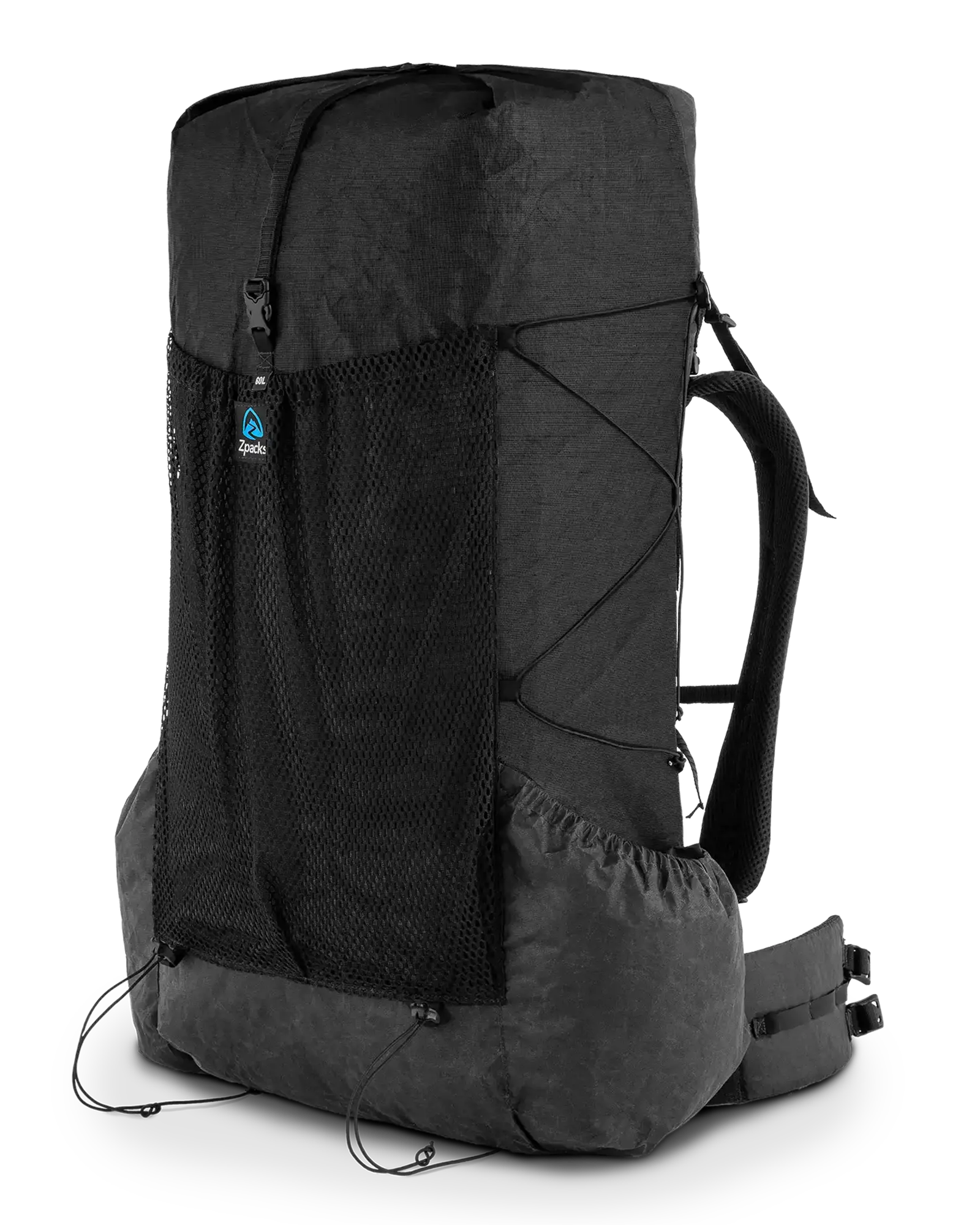
Zpacks Arc Haul Ultra 60L

- Ultra 100X material offers exceptional abrasion resistance for rocky terrain.
- External frame design excels at transferring heavy water and food weight to the hips.
- 21.8 oz weight is highly efficient for a 60L framed pack.
- External frame components require careful handling to avoid damage when off-trail.
- Rigid structure makes it less compressible when empty.
The Arc Haul Ultra 60L Backpack utilizes a frame system that is specifically advantageous for the PCT's most demanding logistical hurdles. When facing the 26-mile dry stretch along the Hat Creek Rim, the ability to comfortably transfer the weight of six liters of water to the iliac crest is critical. The Ultra 100X fabric provides the necessary durability to withstand the loose, rocky soil near Cutthroat Pass and the general abrasion of a 2,650-mile journey. Its 60-liter capacity easily accommodates the hard-sided bear canisters required in Yosemite, Sequoia and Kings Canyon, and Lassen Volcanic National Parks. At 21.8 ounces, it offers a high volume-to-weight ratio, though the external frame does make it slightly bulkier when navigating tight, overgrown brush or public transit during town stops.
Check price →Pack
ULA Circuit
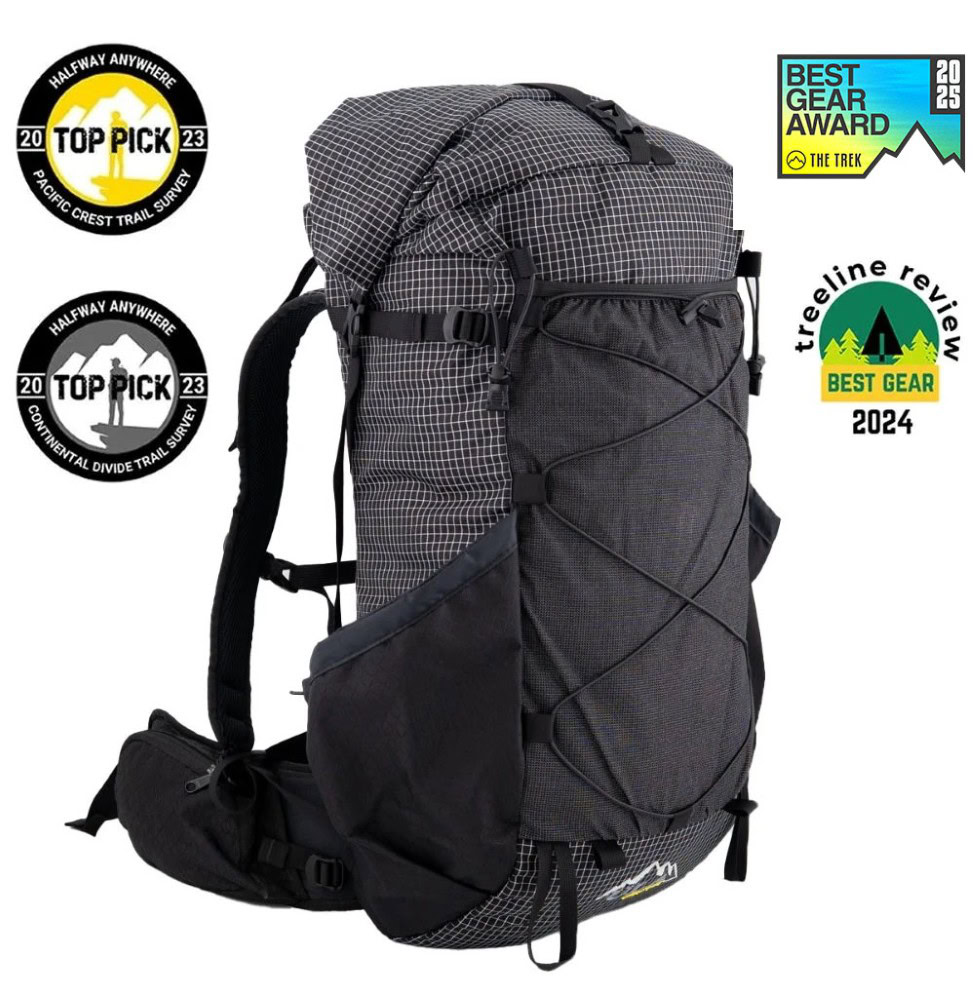
- Internal volume and collar width easily accommodate hard-sided bear canisters.
- Robic nylon construction balances durability with weight.
- Suspension system handles the fluctuating weights of long resupply stretches.
- At 38.5 oz, it is on the heavier end of the ultralight spectrum.
- Hipbelt pockets may not suit all organizational preferences.
The Circuit is a staple on the Pacific Crest Trail due to its proven ability to handle the specific regulatory requirements of the Sierra Nevada. With bear canisters required from the Friday before Memorial Day through October in the Rae Lakes Loop, and mandatory in Yosemite and eight areas of the Inyo National Forest, a pack must easily swallow a rigid cylinder. The Circuit's internal dimensions and roll-top collar are designed to fit standard canisters horizontally or vertically without distorting the back panel. The Robic nylon fabric offers reliable resistance against granite abrasion. While its 38.5-ounce weight makes it heavier than Dyneema or Ultra alternatives, the robust suspension system provides the necessary support for the heavy food carries required when traversing the High Sierra.
Check price →Pack
Hyperlite Mountain Gear Southwest 55L

- Dyneema construction provides excellent tear resistance and weatherproofing.
- Solid fabric external pockets prevent snagging on brush.
- 30.8 oz weight is competitive for a fully framed 55L pack.
- Solid pockets do not allow wet gear to drain or dry easily.
- Dyneema can suffer from abrasion over 2,650 miles if repeatedly dragged on granite.
The Southwest 55L is engineered for environments where standard mesh pockets would be shredded. On the PCT, hikers encounter overgrown chaparral in Southern California and steep terrain with loose, rocky soil due to significant rockfall near Cutthroat Pass. The solid-fabric external pockets on the Southwest prevent snagging and tearing in these conditions. The 55-liter volume is sufficient for the bear canisters required in Desolation Wilderness and the Mt. Baker-Snoqualmie National Forest. At 30.8 ounces, the pack provides adequate load transfer for the heavy water carries required in the desert sections. The primary trade-off is that the solid pockets trap moisture, making it difficult to dry a wet rainfly while hiking.
Check price →Pack
Gossamer Gear Mariposa 60

- Ample pockets allow for excellent gear organization.
- 60-liter capacity easily handles bulky cold-weather gear for Forester Pass.
- Robic nylon is durable enough for the entire 2,650-mile trail.
- 33 oz weight is slightly heavier than minimalist options.
- The wide profile can be cumbersome in tight spaces.
The Mariposa 60 Backpack offers a structural solution for hikers who prioritize organization and volume over absolute minimal weight. The PCT requires carrying diverse gear, from sun umbrellas in the desert to heavy insulation for the 13,180-foot Forester Pass. The Mariposa's 60-liter capacity and ample external pockets allow hikers to store a wet shelter, water filtration system, and daily snacks separately and accessibly. The internal volume is wide enough to accommodate the hard-sided bear canisters required in Lassen Volcanic National Park and the Okanogan-Wenatchee National Forest. The 33-ounce weight and Robic nylon construction provide a reliable balance of durability and load support for the long resupply carries common in the Sierra.
Check price →Pack
Durston Gear Kakwa 55

- The frame provides excellent weight transfer to the hips.
- 1.9 lbs weight is highly competitive for a framed 55L pack.
- Cost-effective option for a fully featured thru-hiking pack.
- Less modularity compared to other ultralight systems.
- Shoulder straps may feel narrow for hikers with broader chests.
The Kakwa 55 addresses the core mechanical requirement of the PCT: transferring fluctuating weight loads to the hiker's hips. Whether loaded with five liters of water for the Hat Creek Rim or eight days of food for the Sierra, the pack's frame prevents shoulder fatigue. At 1.9 pounds, it maintains a strict ultralight profile while offering the 55-liter volume necessary to house the bear canisters required across Yosemite, Sequoia, and Kings Canyon. The fabric balances weight and durability, capable of surviving the grit and rockfall of the northern sections. It represents a highly efficient, pragmatic design for the 2,650-mile journey, focusing on structural integrity rather than extraneous features.
Check price →Pack
Hyperlite Mountain Gear Windrider 55L

- External mesh pockets allow wet shelters and clothing to dry while hiking.
- Dyneema main body offers high water resistance.
- 31.1 oz weight with a frame capable of moderate water carries.
- Mesh pockets are vulnerable to snagging and tearing on overgrown trail sections.
- White Dyneema shows dirt and stains quickly over a thru-hike.
The Windrider 55L utilizes external mesh pockets, which provide a distinct advantage when handling the wetter sections of the PCT, particularly in Washington. Northbound hikers often encounter rain and condensation in the Mt. Baker-Snoqualmie and Okanogan-Wenatchee National Forests. The mesh allows a wet rainfly or damp socks to drain and dry in the wind while hiking. The 55-liter Dyneema main body resists moisture penetration and is large enough to fit the bear-resistant food storage necessary in those same northern forests. Weighing 31.1 ounces, the pack provides the rigidity needed for the heavier loads of the Sierra, though hikers must be cautious not to tear the external mesh on the abrasive rockfall near Cutthroat Pass.
Check price →Weights at a glance
| Role | Item | Weight | Price |
|---|---|---|---|
| Pack | Arc Haul Ultra 60L | 21.8 oz | $399 |
| Pack | Circuit | 38.5 oz | $299.99 |
| Pack | Southwest 55L | 30.8 oz | $420 |
| Pack | Mariposa 60 | 33 oz | $315 |
| Pack | Kakwa 55 | 30.4 oz | $279 |
| Pack | Windrider 55L | 31.1 oz | $420 |

Managing Extreme Water Carries
Water availability fundamentally dictates backpack selection on the Pacific Crest Trail. Unlike trails in the eastern United States where water is abundant, the PCT forces hikers to manage long, dry stretches. The most notorious of these is the Hat Creek Rim in Northern California, where there is often no water available for approximately 26 miles. To safely navigate this section, a hiker must carry between five and six liters of water. Because one liter of water weighs 2.2 pounds, this single requirement adds 11 to 13 pounds of static, dense weight to the pack.
This density requires a backpack with a robust suspension system. Frameless packs, which rely on the rigidity of a folded sleeping pad and internal tension, often collapse under loads exceeding 25 pounds, transferring the weight entirely to the hiker's shoulders. Over a 26-mile stretch, this causes severe fatigue and potential nerve impingement. A pack with an internal stay, a tubular frame, or an external frame is necessary to channel this dense water weight downward into the hipbelt and onto the iliac crest.
Furthermore, the physical volume of water storage must be considered. While bladder systems are an option, most PCT hikers rely on plastic water bottles stored in external side pockets for ease of access and filtration. The side pockets of a chosen pack must be deep enough to securely hold tall, one-liter bottles without them ejecting when the hiker bends over to navigate blowdowns, and the side compression straps must be routed to allow access to the bottles while moving.
The Bear Canister Mandate
Food storage regulations on the PCT are strict, complex, and legally enforced, directly impacting backpack volume and geometry. Bear canisters are not optional suggestions; they are mandatory in multiple jurisdictions. Yosemite National Park requires PCT hikers to carry a bear canister between Glen Aulin and Sonora Pass. In the Rae Lakes Loop area of Sequoia and Kings Canyon National Parks, they are required from the Friday before Memorial Day through October. Furthermore, eight specific areas of the Inyo National Forest, the entirety of Desolation Wilderness, and Lassen Volcanic National Park (from April 16 to November 30) mandate their use.
A hard-sided bear canister is a rigid, unyielding cylinder that dictates how a pack is loaded. A standard large canister has a volume of roughly 11.5 liters and a diameter of nearly 9 inches. Backpacks with narrow circumferences or low overall volumes (under 45 liters) will struggle to accommodate this shape internally. Forcing a canister into a pack that is too small can distort the back panel, turning a flat, comfortable surface into a hard barrel against the hiker's spine.
When selecting a pack, hikers must ensure the main compartment is wide enough to load the canister either horizontally (which is optimal for weight distribution) or vertically. Packs with roll-top closures and Y-straps over the top offer an alternative: strapping the canister to the outside top of the pack. While this frees up internal volume, it raises the center of gravity significantly, which can affect balance when handling the steep, loose, rocky soil found near Cutthroat Pass or the granite steps of the Sierra.
Terrain, Abrasion, and Material Durability
Over its 2,650-mile length, the PCT subjects gear to relentless physical abrasion and ultraviolet degradation. The trail transitions from the sharp chaparral and abrasive sand of the Southern California desert to the jagged granite of the High Sierra, and finally to the dense, wet forests of the Cascades. Approximately 4 miles north from Cutthroat Pass, the trail features steep terrain with loose, rocky soil due to significant rockfall. A pack must survive being dropped on granite, dragged through brush, and subjected to months of direct, high-altitude sunlight.
Material selection is the primary defense against this wear. Dyneema Composite Fabrics (DCF) offer exceptional water resistance and high tensile strength at a very low weight, making them popular for the PCT. However, DCF can be susceptible to abrasion if repeatedly scraped against granite. Ultra fabrics, such as Ultra 100X, weave UHMWPE fibers into a face fabric, providing significantly higher abrasion resistance than standard DCF while maintaining a low weight. This makes Ultra highly suitable for the rocky, loose terrain of the northern sections.
Robic nylon remains a highly durable and cost-effective alternative. While slightly heavier than DCF or Ultra, high-denier Robic nylon resists the micro-abrasions caused by trail dust and sand working their way into the fabric weave. Regardless of the main body material, hikers must pay close attention to the external pockets. Mesh pockets are excellent for drying gear but are highly vulnerable to tearing on overgrown trail sections; solid fabric pockets offer better protection but trap moisture.
Navigating Permits and Regulations
The logistics of a PCT thru-hike are governed by a strict permitting system that affects daily planning and gear requirements. A long-distance permit is issued by the PCTA for continuous hikes of 500 miles or more. This interagency permit simplifies travel across dozens of jurisdictions. For example, hikers with a valid interagency PCT long-distance permit can camp in the Yosemite Wilderness without an additional local permit, provided they adhere to the bear canister regulations required between Glen Aulin and Sonora Pass.
The permit also provides specific exemptions in closed areas. The Deep Creek Area Closure includes Deep Creek and extends 50 feet out from both sides, but hikers with a valid PCT Long-distance Permit may use specific spur trails. Understanding these boundaries is critical for planning water stops and campsites. Additionally, fire regulations are stringent: a California Campfire Permit is required to use a stove, lantern, or build a campfire on much of the PCT within California. This means even hikers using a standard isobutane canister stove must carry this permit.
Finally, international borders dictate the trail's conclusion. The Pacific Crest Trail permit program for entering Canada has ended. Anyone completing the Canadian portion must use a designated port of entry, meaning hikers can no longer simply walk across the border via the trail to Manning Park. This forces northbound hikers to plan a return route back to a U.S. Trailhead, requiring them to carry enough food and fuel for the extra mileage, further emphasizing the need for a pack with adequate volume and load-bearing capacity.
Layering and Volume for Extreme Elevation
The northbound thru-hike window, starting between mid-April and mid-May, forces hikers to experience massive temperature swings. The initial 700 miles through the desert require minimal insulation but maximum water capacity. However, upon entering the Sierra Nevada, the environment changes drastically. The highest point on the entire trail is Forester Pass, which sits at an elevation of 13,180 feet and serves as the boundary between Sequoia and Kings Canyon National Parks. At this elevation, hikers face freezing temperatures, high winds, and potentially deep snow.
This dramatic shift requires a backpack capable of expanding to accommodate bulky insulation layers, a warmer sleeping bag, microspikes, and an ice axe, while still housing the mandatory bear canister. A pack that was perfectly sized for the desert may suddenly be too small for the Sierra. Roll-top closures are essential here, allowing the pack's internal volume to expand to hold an extra synthetic jacket or a heavier quilt.
Conversely, once the hiker descends from the high elevations and the weather warms, or during the frequent short resupply stretches in Oregon, the pack must compress efficiently. A 60-liter pack carrying only two days of food and minimal water will feel sloppy and unbalanced if it cannot be compressed. Side compression straps and a roll-top that can be cinched down tightly to the frame are necessary to keep the load stable against the hiker's back when the internal volume is largely empty.
Mistakes to avoid on this trail
- Selecting a pack with a circumference too narrow to accommodate a hard-sided bear canister horizontally, resulting in a barrel-shaped back panel.
- Using a frameless pack without considering the 11-13 pound weight penalty of carrying 5-6 liters of water across the 26-mile Hat Creek Rim.
- Relying entirely on fragile external mesh pockets, which are easily shredded by overgrown chaparral and the loose, rocky soil near Cutthroat Pass.
- Failing to account for the extra volume needed for cold-weather insulation and traction devices required to safely cross the 13,180-foot Forester Pass.
- Assuming the PCT Canada permit program is still active and failing to plan the extra food and pack volume needed to hike back to a U.S. Trailhead from the northern terminus.
FAQ
Do I need a bear canister for the entire Pacific Crest Trail?
How much water capacity does my pack need for the PCT?
Can I use a frameless backpack on the PCT?
Do I need a permit just to use my camping stove?
The bottom line
Selecting a backpack for the Pacific Crest Trail requires balancing the conflicting demands of a 2,650-mile journey. The pack must possess a suspension system robust enough to handle the 13-pound water carries of the Hat Creek Rim, yet remain light enough to facilitate 20-mile days. Furthermore, its internal geometry must accommodate the hard-sided bear canisters mandated across the Sierra and Cascades. By prioritizing load transfer, abrasion-resistant materials, and adaptable volume, hikers can ensure their pack withstands the transition from desert heat to the 13,180-foot extremes of Forester Pass.
Related guides
Keep building your system with these closely related guides.
- PCT Gear Guide: The Best Ultralight Quilts for the Trail
- The Best Ultralight 3-Season Tents for the PCT
- PCT Gear List: An Ultralight Kit Under 10 Pounds
- 5 Best Ultralight Backpacks for Thru Hiking, Ranked and Tested
- Colorado Trail
- Continental Divide Trail
Further reading
Authoritative sources to go deeper on the topics above.